« Last post by Buster's Uncle on December 16, 2025, 06:54:54 pm »
Reuters Russia says damaged launch pad crucial to its space programme will be fixed by February Reuters Tue, December 16, 2025 at 5:22 AM EST 1 min read
MOSCOW, Dec 16 (Reuters) - Russia's space agency said on Tuesday that work was underway to repair a damaged launch pad at the Baikonur cosmodrome in Kazakhstan that underpins its space programme and that the facility should be back in use by February of next year.
The pad was badly damaged in November when a Russian Soyuz MS-28 spacecraft with two Russian cosmonauts and one NASA astronaut on board blasted off.
Although the launch was successful, Roscosmos, Russia's space agency, later said a post-launch inspection had uncovered damage to the pad and that it would have to undergo repairs, notably to its "service cabin" - a platform located beneath the upper level - before it could be used again.
While Russia has other cosmodromes on its own territory and Baikonur has other launch sites, the damaged launch pad - number 31 - is the only one able to handle launches of the Soyuz rocket and crew capsule as well as the cargo-only Progress vehicle, which are crucial for the International Space Station.
Roscosmos said on Tuesday that more than 130 people were racing to fix the pad, operating in two shifts from 8 a.m. to midnight.
All necessary spare parts were on site and being prepared for assembly, and testing would be conducted once the new service cabin was in place, it said.
"Work on restoring the service cabin and launch pad is being carried out at full speed," said Dmitry Baranov, deputy general director of Roscosmos.
"According to the confirmed timetable it will be ready to handle the first launch by the end of winter 2026."
(Reporting by Andrew OsbornEditing by Ros Russell)
« Last post by Buster's Uncle on December 16, 2025, 06:49:30 pm »
Live Science Deep snow blanket transforms Yellowstone Lake into a giant white void — Earth from space Harry Baker Tue, December 16, 2025 at 3:00 AM EST 3 min read
Yellowstone Lake transforms into a featureless white void during the winter months, when snow and ice cover its surface. | Credit: NASA/ISS program
QUICK FACTS
Where is it? Yellowstone National Park, Wyoming [44.46284445, -110.3628428]
What's in the photo? A perfectly white blanket of snow covering Yellowstone Lake
Who took the photo? An unnamed astronaut on board the International Space Station (ISS)
When was it taken? Jan. 26, 2022
This eye-catching astronaut photo shows Yellowstone's eponymous lake covered in a thick blanket of snow, making it look like a colorless, featureless void in the surrounding landscape. But below this freezing, blank expanse lies some of the most active and hottest hydrothermal vents anywhere on Earth.
Yellowstone Lake is the largest body of water in Yellowstone National Park and the largest high-elevation lake in North America, sitting at 7,733 feet (2,357 meters) above sea level, according to the National Park Service (NPS). It is around 20 miles (32 kilometers) across at its widest point and has a maximum depth of 410 feet (125 m).
The lake freezes over every winter, around late December or early January, with an ice sheet that ranges from a few inches to around 2 feet (0.6 m) thick. But the blanket of snow on top of this ice can reach up to 3.5 feet (1.1 m) deep by March, according to NASA's Earth Observatory. The lake is usually snow- and ice-free by late May or early June.
The thick covering of snow means Yellowstone Lake is remarkably resilient to human-caused climate change, maintaining its surface ice thickness despite rising atmospheric temperatures. This makes it a major outlier among high-altitude lakes across the globe.
This astronaut photo shows one of these deep snowdrifts, mostly undisturbed aside from a few islands, the largest of which is Stevenson Island.
The snow covering Yellowstone Lake can reach up to 3.5 feet (1.1 m) deep. This photo of the lake was taken in February 2014. | Credit: Smith Collection/Gado/Getty Images
While the surface of Yellowstone Lake may seem cold and lifeless during the winter months, the water below remains surprisingly mild thanks to a series of hydrothermal vents across its floor. This enables aquatic animals, including the lake's cutthroat trout (Oncorhynchus clarkii) population — the largest of its kind anywhere in North America — to survive the long months under the ice, according to NPS.
One of the vents, right next to Stevenson Island, releases water that’s a remarkable 345 degrees Fahrenheit (174 degrees Celsius), making it hotter than Old Faithful and every other geyser or hot spring in Yellowstone National Park.
"This is much hotter than any surface hot spring at Yellowstone because the weight from the overlying lake water acts like a pressure cooker lid and allows temperatures higher than boiling to be reached," representatives from the U.S. Geological Survey wrote in an article about the lake's vents. "These are the hottest hydrothermal vents measured in a lake anywhere in the world."
The vents are powered by a giant blob of magma, around 2.6 miles (3.8 km) beneath Yellowstone National Park, which contains a surprising amount of molten rock. This magma blob acts like the cap on a gigantic volcanic bottle and will one day explode, unleashing a "supervolcanic" eruption that could be felt across the continent.
Yellowstone Lake was formed shortly after a similar eruption 640,000 years ago, which carved out the 1,500-square-mile (3,900 square kilometers) caldera that the lake currently sits within. Around 130,000 years ago, a smaller eruption then carved out the doorknob-shaped handle of the lake, dubbed West Thumb (visible near the top of the astronaut photo).
« Last post by Buster's Uncle on December 16, 2025, 06:41:19 pm »
Nautilus Ancient Math Hidden in Oldest Known Floral Pottery Molly Glick Mon, December 15, 2025 at 8:00 PM EST 2 min read
Lead image: Osama Shukir Muhammed Amin FRCP(Glasg) / Wikimedia Commons
If you take a close look at the pottery bearing some of the oldest known plant art, you can find the buds of mathematics—advancements that seem to have emerged millennia before the invention of writing or formal numeric systems.
It’s difficult to track humanity’s development of mathematical skills before writing or numbers came onto the scene, but art can offer some promising hints. Early ancient art mostly consisted of relatively straightforward depictions of animals and humans, but later works represent a critical shift in which people began to exhibit more complex visual flair and an increasing grasp of geometry.
This includes sophisticated pottery from the Halafian culture of northern Mesopotamia, a society of farmers. A team from the Hebrew University of Jerusalem in Israel analyzed ancient botanic illustrations found on Halafian pottery from 29 archeological sites spanning 6200 to 5500 B.C. to learn more about these floral findings.
EARLY GEOMETRY: Researchers found carefully designed symmetrical arrangements of flower petals on Halafian pottery. Image from Garfinkel, Y., et al. Journal of World Prehistory (2025).
“These vessels represent the first moment in history when people chose to portray the botanical world as a subject worthy of artistic attention,” the study authors, Hebrew University archeologists Yosef Garfinkel and Sarah Krulwich, said in a statement. “It reflects a cognitive shift tied to village life and a growing awareness of symmetry and aesthetics.”
By closely inspecting more than 700 pottery fragments adorned with plant motifs, Garfinkel and Krulwich noticed a fascinating pattern: They found floral bowls with petals arranged into geometric sequences of 4, 8, 16, 32, and 64, findings reported in the Journal of World Prehistory.
“The ability to divide space evenly, reflected in these floral motifs, likely had practical roots in daily life, such as sharing harvests or allocating communal fields,” Garfinkel added.
This suggests that these pieces of pottery were more than pretty possessions—they helped people make sense of their surroundings and think through complicated tasks. This unfolded thousands of years before the world’s first known writing system, cuneiform, emerged in Mesopotamia around 3000 B.C.
“These patterns show that mathematical thinking began long before writing,” Krulwich said. “People visualized divisions, sequences, and balance through their art.”
« Last post by Buster's Uncle on December 16, 2025, 06:34:43 pm »
ScienceAlert Psilocybin Breaks Depressive Cycles by Rewiring The Brain, Study Suggests Tessa Koumoundouros Mon, December 15, 2025 at 6:50 PM EST 3 min read
Psilocybin Breaks Depressive Cycles by Rewiring The Brain, Study Suggests
Scientists have used a specially engineered virus to help track the brain changes caused by psilocybin in mice, revealing how the drug could be breaking loops of depressive thinking.
This may explain why psilocybin keeps showing positive results for people with depression in clinical trials.
"Rumination is one of the main points for depression, where people have this unhealthy focus, and they keep dwelling on the same negative thoughts," says Cornell University biomedical engineer Alex Kwan.
"By reducing some of these feedback loops, our findings are consistent with the interpretation that psilocybin may rewire the brain to break, or at least weaken, that cycle."
Depression is a leading global cause of disability, with more than 300 million people impacted by the mood disorder.
Many people find current treatments have challenging side effects or do not work for them at all, so there is an ongoing search for alternative solutions, such as psilocybin.
How psilocybin changes the connections between mouse neurons. (Jiang et al., Cell, 2025)
Derived initially from magic mushrooms, psilocybin is a hallucinogenic compound that is being investigated for its anti-inflammatory properties in addition to its potential as an antidepressant.
In 2021, Kwan's laboratory showed that psilocybin reshapes brain connections, finding these changes could last for a long time. But why some neurons grew more connections, while others reduced them, was a mystery.
In their new study led by biomedical engineer Quan Jiang, the researchers took a closer look at which brain circuits were being rewired and how, using an engineered rabies virus to track changes in brain connections.
In its natural form, the rabies virus spreads through neurons, jumping across synapses.
"Here we use the rabies virus to read out the connectivity in the brain," explains Kwan.
The virus trailed paths of fluorescent proteins through the mouse brains. Mice received a single dose of psilocybin or a placebo and then, one day later, the virus. One week later, the researchers compared the viral 'trails'.
Scans revealed areas of the brain associated with sensory processing became more connected with the part of the brain that takes action.
What's more, connections within the cortex, where negative thought feedback loops take place in humans, were reduced.
Jiang and team also found that brain activity seems to direct where psilocybin rewiring occurs, opening the prospect of using methods like magnetic stimulation to modulate targeted neural activity.
Of course, these findings still need to be confirmed in humans, as not all findings from research in mice translate across species.
But the results would explain some of the results of human observation studies, and one of the most compelling ideas about how psychedelics work.
"Our study hints at an exciting avenue for future research to combine neuromodulation with psychedelics to precisely target [and rewire] specific circuits," the researchers conclude.
« Last post by Buster's Uncle on December 16, 2025, 06:27:12 pm »
The Cool Down Experts outline solution to growing ring of space trash orbiting our planet: 'I've never seen it presented this way' Kim LaCapria Mon, December 15, 2025 at 5:20 PM EST 2 min read
Experts outline solution to growing ring of space trash orbiting our planet: 'I've never seen it presented this way'
Space junk is perhaps a silly-sounding name, and while it's not new, the rise of private aerospace firms has exacerbated this very real and serious problem.
Also called "space debris," human-made detritus floating in space began accumulating with the launch of Sputnik 1 in 1957.
As CNN recently reported, trash in low orbit has been building up "at a fantastic pace" in recent years due to private launches — but researchers have hit upon a potential approach to solving this growing problem, one that might sound familiar to the eco-minded people of Earth.
Although orbiting debris hasn't posed much of a direct risk to humans for much of Earth's space-faring history, that's changing.
A crew was recently stranded in orbit after space junk damaged their capsule, and one startup developed a protective suit to protect astronauts from this dangerous debris.
On Dec. 1, a team from the University of Surrey in the United Kingdom published a paper in the journal Chem Circularity, applying the principles of a circular economy not just to rapidly accumulating space junk, but also to unnecessary, avoidable waste in the aerospace sector.
As the authors observed, most missions are structured as single-use, with no provision for recovery, meaning "valuable materials are lost."
In that respect, their findings went beyond just tackling garbage in space, which often falls to Earth, posing risks to humans and ecosystems in its path. Researchers analyzed supply chains to identify inefficiencies in the space sector during the study.
The study's abstract applied the principles of reducing, reusing, and recovering to the aerospace industry as "a promising lens through which to reimagine material use in space and on Earth."
The team proposed using cutting-edge AI modeling tools and digital twins, finding that AI analysis in particular had "significantly advanced the development of space sustainability" despite limited access to datasets.
University of North Dakota space studies professor Michael Dodge was not involved in the study, but he told CNN that the researchers' solutions to aerospace waste and space junk were wholly novel.
"I've never seen it presented this way. It's an area that needs to be discussed further," Dodge said.
« Last post by Buster's Uncle on December 16, 2025, 06:21:27 pm »
Live Science 5,000-year-old dog skeleton and dagger buried together in Swedish bog hint at mysterious Stone Age ritual Kristina Killgrove Mon, December 15, 2025 at 4:23 PM EST 3 min read
The bone dagger (bottom center) in relation to the dog skeleton (center). | Credit: Arkeologerna, SHM
Archaeologists have found the skeleton of a dog alongside a bone dagger at the bottom of a bog in Sweden. The remains are thought to be 5,000 years old and may be from a mysterious Stone Age ritual.
The unique dog burial was identified during construction work for a high-speed railway in the hamlet of Gerstaberg, about 22 miles (35 kilometers) southwest of Stockholm. Experts with the Swedish group Arkeologerna (The Archaeologists) announced the find in a statement and blog post Monday (Dec. 15).
Five millennia ago, this swampy bog was a clear lake that Stone Age people fished in. Wooden pilings and pieces of an ancient pier were discovered on the lake bed, along with a structure made from intertwined willow branches and a woven fishing basket.
But the dog skeleton and nearby dagger surprised the archaeologists.
"Finding an intact dog from this period is very unusual, but the fact that it was also buried together with a bone dagger is almost unique," Linus Hagberg, a project manager at Arkeologerna, said in the translated statement.
While the exact breed of dog is not yet known, it was a large and powerful 3- to 6-year-old male that stood about 20 inches (52 centimeters) tall. The dog had been placed in a leather bag weighted down with stones to sink it to a depth of about 5 feet (1.5 m).
"It is a known phenomenon that dogs were used in ritual acts during this period," Hagberg said.
Directly adjacent to the dog skeleton, the archaeologists found a well-preserved, 10-inch-long (25 cm) dagger made of elk or red deer bone. According to the Arkeologerna blog post, "daggers of this type should be considered a symbolically charged object," and other examples have been discovered in wet and boggy places in Stone Age Sweden.
« Last post by Buster's Uncle on December 16, 2025, 06:12:17 pm »
Live Science 15-year cosmology study confirms there's a big problem in our understanding of the universe Paul Sutter Mon, December 15, 2025 at 4:50 PM EST 4 min read
A photograph of the Atacama Cosmology Telescope in Chile overlaid with a figure from its final data release. The figure shows the direction of magnetic polarization in microwaves from some of the earliest epochs of the universe. . | Credit: Princeton University (background), The Atacama Cosmology Telescope collaboration (boxout)
After a multi-decade-year mission to understand the nature of the universe, a telescope perched in the mountain plateaus of northern Chile said goodbye in 2022. Now, its final data release is revealing the telescope's legacy: a field in tension.
In October 2007, the Atacama Cosmology Telescope (ACT) saw its first light. But it was not light from a star, or even a distant galaxy. Instead, ACT was designed to hunt for microwaves, especially the kind of microwaves left over from some of the earliest epochs of the universe. This "fossil" light, known as the cosmic microwave background (CMB), was emitted when the universe was just 380,000 years old.
The CMB offers cosmologists a pristine look at the infant cosmos. ACT was designed to complement other surveys, like the European Space Agency's Planck satellite. The Planck mission launched an orbiting spacecraft to provide a whole-sky census of the CMB. But its resolution was limited, especially in studies of the CMB's polarization (the direction in which oscillations in the CMB's magnetic and electric field point as the light travels). In contrast, even though ACT is ground-based, it could search deeper into smaller pockets of the CMB sky at a very high resolution.
ACT was especially good at looking at the CMB's polarization, which tells us a lot about the state of the early universe. If you change the amount of dark matter in the cosmos, how it's distributed, how many neutrinos there are, or any of another dozen or so properties of the cosmos, you change what the CMB's light looks like.
Final ACT
In November, the ACT team released their sixth and final public dataset as threearticlespublished in the Journal of Cosmology and Astroparticle Physics. While cosmologists will continue to mine the data for many years to come, the core team also provided their final suite of analyses and studies before saying farewell for good.
Their findings matched what surveys like Planck had already identified: that something funny is going on with the expansion of the universe. Measurements of the present-day expansion rate, known as the Hubble rate or Hubble constant, taken with early-universe probes like Planck and ACT, reveal a number that is quite a bit slower than estimates based on nearby measurements, like supernova dimming.
This discrepancy has come to be known as the Hubble tension, and it is perhaps the greatest unsolved mystery in modern cosmology. But ACT didn't just confirm the existence of the tension; it also destroyed some very good ideas.
A map of microwave intensity (orange to blue) overlaid with the direction of magnetic polarization in those microwave emissions. Studying the cosmic microwave background (CMB) is helping astronomers fine tune measurements of the universe's expansion. | Credit: The Atacama Cosmology Telescope collaboration
ACT axes 30 cosmic models
Cosmologists have been busy concocting many theoretical explanations for the Hubble tension. Many of these are called "extended" cosmological models, since they take the standard cosmological picture and add a few extra ingredients or forces to the universe.
But these ingredients and forces don't just exist today; they also must have existed when the CMB was first emitted. So ACT's exquisite view of the CMB allowed the team to put many of these models — around 30, in fact — to the test.
All of them failed.
But in science, you only lose if you don't learn anything, and ACT's negative results help cosmologists in their search. In other words, you can only know the right answer once you've crossed off all the wrong answers.
« Last post by Buster's Uncle on December 16, 2025, 06:03:02 pm »
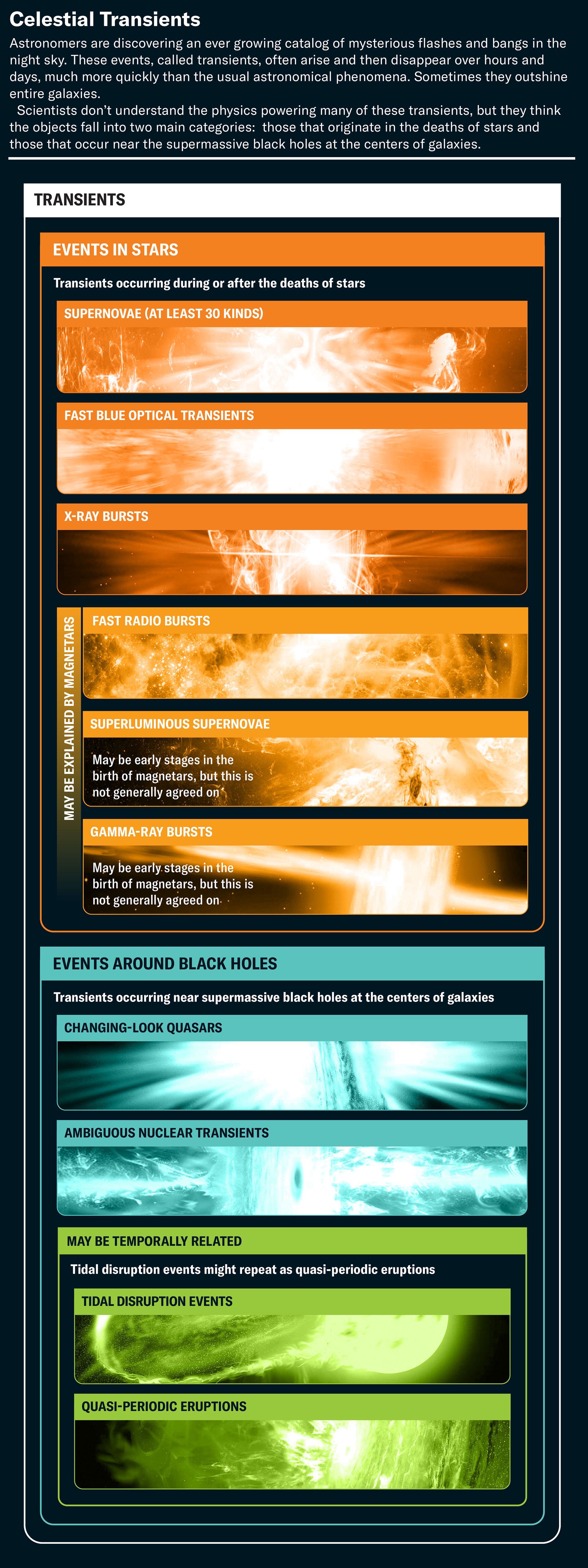
Scientific American Mysterious Bright Flashes in the Night Sky Baffle Astronomers Celestial transients shine furiously and briefly. Astronomers are just beginning to understand them Ann Finkbeiner Tue, December 16, 2025 at 6:00 AM EST 17 min read
Long, long ago a cloud of stars circled a galaxy-size black hole, safely at a distance. Then about 200 million years ago one member of the cloud bumped another, a sun-size star, and sent it toward the black hole. The black hole was a million times more massive than the sun-size star, and its gravitational pull proportionately stronger, so the star was drawn closer and closer—until it got too close. Some of the star’s gas was pulled into an orbiting stream around the black hole that widened into a flat pancake called an accretion disk. The rest of the star came apart in a sudden and great flash of light.
On September 19, 2019, just before noon, the flash reached the 1.2-meter mirror of the Zwicky Transient Facility in southern California. Astronomers named the flash AT2019qiz and noted that they hadn’t seen it three days before. On September 25, 2019, the 10-meter Keck I telescope in Hawaii identified AT2019qiz as a so-called tidal disruption event—a flare-up that occurs when a black hole’s gravitational tides rip a small object apart. The star the size of the sun exploded with 10 billion times the sun’s luminosity.
But AT2019qiz wasn’t finished yet. An entirely unrelated star, maybe from the same cloud, was on an orbit that intersected AT2019qiz’s newly created disk. Each time this other star splashed into the disk, it flashed, though less brilliantly than the original, pulled-apart star. In December 2023 the brightness of AT2019qiz (now the name of the disrupted star, the accretion disk and the flaring star that ran into them) peaked, dimmed down and then shot up again—a pattern that repeated nine times. Each flash marked a pass of the interloper through the disk, which occurred every 48 hours. Between 2019 and 2024, astronomers observed AT2019qiz with telescopes on the ground and in space, at wavelengths from x-ray through ultraviolet, optical and infrared. The multitelescope, multiwavelength data together confirmed that AT2019qiz was first a tidal disruption event and then a “quasi-periodic eruption.” Both are examples of phenomena astronomers call transients. Both involved unspeakable violence on unearthly scales. Neither could have been identified 20 years ago.
Transients, which are astronomical objects that appear suddenly from nowhere and usually disappear soon after, contradict the standard truth that the universe changes predictably and slowly over billions of years. They include what the typically staid National Academy of Sciences called “the most catastrophic events in spacetime.” They are astronomically sized objects that change on human timescales—in seconds, hours, days—which is a combination of size and speed that seems impossible. If we didn’t observe them, says astronomer Vikram Ravi of the California Institute of Technology, “you’d never know that physics allows these things to exist.”
But physics says everything not forbidden will, sooner or later and with some probability, happen. And astronomers, noticing these improbable things and knowing that nothing is one of a kind, began to find many more, all at the far reaches of physics. Between 1976 and 2012, the number of transients listed on the International Astronomical Union’s official Transient Name Server was around five each year. Between around 2013 to 2015, that number jumped to about 100. Since 2019, scientists have seen roughly 20,000 a year. At press time, the total was 175,953 transients. Chart this rise, and it looks like a long tail with an elephant attached.
The growth has been the result of a large number of astronomical surveys, most still ongoing, “vacuuming the whole sky,” says experimental physicist Christopher Stubbs of Harvard University. For instance, the Zwicky Transit Facility, which started the jump in detections in 2019, scans the entire northern sky every two nights and compares each evening’s images with the ones taken two nights before. And the Vera C. Rubin Observatory in Chile, which came online in 2025, will soon survey the entire southern sky every three nights, identifying changes within 60 seconds of their detection to create near-real-time movies of the sky and finding 10 million changes every day. The elephant will go seriously nonlinear.
With such a large amount of data, astronomers can begin to study credible demographics: that is, they can move from just finding these wild, unlikely creatures to figuring out what they are. Because things that happen once and disappear are hard to study, the transients’ identities—the physics that drives them, the processes that produce them—are still speculative. Most of their names are just adjectives, and “when the transient’s name is a description,” says astrophysicist Raffaella Margutti of the University of California, Berkeley, “that tells you we know nothing intrinsic about them.” That’s about to change.
Scientists sort transients into two main groups: events involving the deaths of stars and events around supermassive black holes in the centers of galaxies. The first known transients fell into the former category: they were supernovae, or massive stars that blow up. Before the 1600s, astronomers confidently knew of five of them; now they count tens of thousands. Supernovae fit into two general categories. One kind is the dead core of a star pulling gas from a nearby star, piling up mass until nuclear fusion restarts and goes critical and the whole thing pops off like a 20-billion-billion-billion-megaton thermonuclear bomb, which it is. It explodes in a day, stays bright for days to weeks, and fades out over months.
The other type of supernova is called a core collapse: A star burns through enough of its fuel and is massive enough that the outward push of its radiation loses to the inward pull of its gravity. Its core collapses in on itself so thoroughly that its electrons meld with the nuclei of its atoms until the star is made mostly of neutrons—a neutron star—and it shrinks in the space of one second from a radius of about 6,000 kilometers to about 10 kilometers. The collapse causes a shock wave that breaks out of the star’s remaining atmosphere with a flash called a shock breakout, and minutes later the star is as bright as 10 billion suns. It fades out over months; the remnant is called a neutron star.
Beyond these two main categories, though, are many variants—the Transient Name Server identifies 31 types so far. One new kind, called a gap transient, is dimmer and probably less massive than other supernovae, and nobody knows why it explodes. Another is a superluminous supernova, twice as luminous as a core collapse supernova; it has the light of 20 billion suns, and nobody knows why it’s so bright. Supernovae are by far the most numerous of the stellar-death transients, but, as astronomer James E. Gunn of Princeton University points out, stars have “a vast number of interesting ways to die.”
Ron Miller (illustrations) and Jen Christiansen (graphic)
In 1967, for instance, the U.S. Vela satellites detected surprising flashes of extremely energetic gamma rays that could have been (but weren’t) illegal nuclear tests in Earth’s atmosphere; the National Enquirer thought similar flashes seen later might be a space war between alien civilizations. Eventually astronomers pooled data from the U.S. and the U.S.S.R. to identify the flashes, which were the first known gamma-ray bursts—a class of transients now understood to be “the brightest of the brightest,” says astrophysicist Peter Jonker of Radboud University in the Netherlands, who observes space in high-energy wavelengths. Their light rises in seconds to the brightness of a trillion suns, and they last for seconds to hours. The fastest ones might be massive stars going supernova, collapsing so thoroughly that they don’t stop at neutron stars and instead condense into star-size black holes that aim high-intensity jets of plasma at Earth.
Gamma-ray bursts may or may not be related to other high-energy stellar deaths called fast x-ray transients. Discovered in 2008, they number only around 70, although this tally will soon change. China’s Einstein Probe, an x-ray satellite telescope that began collecting data in mid-2025, should find 50 to 100 fast x-ray bursts a year. “The next few years could be dramatic,” says astronomer Mansi Kasliwal of Caltech. Meanwhile, because fast x-ray transients are still rare, no one is ready to say what they are—maybe massive stars exploding, maybe neutron stars colliding before disappearing into black holes.
Another dramatic rarity is called a fast optical blue transient, or FBOT—“fast” because although it explodes at the same outrageous brightness as a superluminous supernova, its light rises and falls not in months but in days. The first FBOT, found in 2018, is officially named AT2018cow and is called Cow for short. Since then, scientists have seen 12 more Cow-like FBOTs. Astronomers know they’re not supernovae—“the energy source of the normal supernovae doesn’t work” for Cows, Margutti says—but aren’t sure what they are. Maybe they flash when a nearby star’s mass piles up onto a neutron star or a modest-size black hole, or maybe they represent shock breakouts from a star that puffed up in its later years. “Whatever they are,” says astronomer Anna Y. Q. Ho of Cornell University, who helped to find the original Cow, “they’re interesting.”
In 2007 radio astronomer Duncan Lorimer and astrophysicist Maura McLaughlin, who are colleagues at West Virginia University and married, were looking in the archives of a radio telescope survey at a small galaxy 200,000 light-years away. They were interested in pulsars, which are rotating neutron stars that release jets of radio light from their magnetic poles. These lighthouselike jets sweep the sky so that whatever is in their path is exposed to a metronomically regular radio pulse every few seconds to milliseconds.
In the course of their search, Lorimer and McLaughlin found a radio spike that lasted a few milliseconds, but it didn’t pulse and was so bright it saturated the telescope’s instrument. Lorimer calculated its distance as seven billion light-years away. “Oh,” he thought, “it’s really far.” Anything that distant and still that bright had to be sending out a billion times more energy than nearby pulsars.
This odd find is now called the Lorimer Burst. Surveys have since identified several thousand of these so-called fast radio bursts scattered throughout other galaxies, emitting in one millisecond the radio energy sent out by the sun in 100 years. “These things are weird,” Lorimer says.
Some of these possible stellar death transients could be related to a deeply strange object called a magnetar. Magnetars existed only in theory until they were observed in 1998. Their weirdness quotient is high even among transients. A magnetar is a neutron star that “rotates ridiculously fast,” making a full turn in milliseconds, says Daniel Kasen of the University of California, Berkeley, “but with a ridiculously high magnetic field.” The strength of the sun’s magnetic field is somewhere around 10 gauss; a magnetar’s is 1014 gauss or higher. That field is “so high it’s unstable,” Ravi says. “It chaotically reconfigures itself.”
Transients are astronomically sized objects that change on human timescales—in seconds, hours, days.
The object’s magnetic field lines twist and snap and reconnect, and in the process they send out flares. The combination of absurdly strong magnetic fields and absurdly fast rotation leads to lots of explosive physics, Kasen says. In 2004 a flare from one magnetar halfway across the Milky Way ionized the upper layers of Earth’s atmosphere. Astronomers know of around 30 of them in our galaxy so far.
“Magnetars are invoked to explain a lot of things we don’t understand,” says Brian Metzger of Columbia University, a theoretical astrophysicist who specializes in stellar-death transients. For instance, different transients might be different phases of a magnetar’s life. Magnetars might be born in the core collapse of the same massive stars as superluminous supernovae. A supernova might then condense into a pulsar and send out jets that are seen as gamma-ray bursts. Later, when the magnetar’s spin period has slowed from milliseconds to seconds, its flares may be seen as a fast radio burst. Magnetars might even explain FBOTs, Ho says, but so far FBOTS are too distant for scientists to be sure.
The stellar-death transients are dying in ways intrinsic to stars. But stars can also die because they’re just in the cosmically wrong place, in the nuclei of galaxies with supermassive black holes. These “nuclear transients,” the second overall category of transients, have turned up only in the past decade. They’re rare and barely understood.
One reason for that is that nuclear transients “are a minefield of contamination,” says Suvi Gezari of the University of Maryland, College Park. Astronomers must distinguish the flashes of nuclear transients from supermassive black holes whose behavior varies. One percent of supermassive black holes, the quasars, are furiously, actively accreting gas and shine so brightly they can be seen near the beginning of the universe. Most of the rest are inactive and just flickering; they have gravitationally cleared out much of the space around them, and their brightness varies by just 10 to 45 percent. And another, unknown fraction are not accreting at all; they’re completely black and invisible.
Nuclear transients are not active quasars, and they don’t flicker—they’re cosmic flash-bangs. One kind is a tidal disruption event such as AT2019qiz, a star trapped in a supermassive black hole’s gravitational field and torn to smithereens. Astronomers have found around 100 tidal disruption events, each visible for a few months in the x-ray, optical and ultraviolet ranges, each with its own small accretion disk that lasts for a few tens of years. Maybe one in 10 tidal disruption events do what AT2019qiz did and become the site of another kind of nuclear transient, the quasi-periodic eruption. In these cases, an errant star passes through the tidally disrupted star’s accretion disk and flares up in x-rays to the brightness of a billion suns. Such flares last minutes and repeat in hours to weeks.
Other nuclear transients may not involve stars at all and may reflect odd behavior of the black holes. One kind of transient discovered in the past decade is called a changing-look quasar (CLQ). It has the brightness of a normal quasar but rapidly changes its appearance in unexplainable ways. It should take thousands of years for a quasar to switch off and go from brilliantly active to quietly inactive. Yet astronomers have found dozens to hundreds of CLQs that change their looks by 200 percent in months—they change so much and so quickly that “they’re not theoretically explainable,” says astrophysicist Paul Green of the Center for Astrophysics | Harvard & Smithsonian. Maybe they’re the aftermath of a long-gone tidal disruption event, or maybe, he says, “we haven’t watched long enough to see a change of state that’s lasting.”
As if CLQs weren’t improbable enough, astronomers also find ambiguous nuclear transients (ANTs), whose problem is in their name: “They’re ambiguous,” says astrophysicist Philip Wiseman, who studies nuclear transients at the University of Southampton in England. They are a diagnosis of exclusion, a flash that isn’t any other transient. ANTs are brighter than all transients except gamma-ray bursts. Their light rises slowly over months and lasts for two or more years. They’ve been found in data archives in numbers from a few to hundreds, depending on who’s defining them. “We can find them, but we don’t know what they are,” says astronomer Matthew Graham of Caltech, another nuclear-transients specialist.
These events are flashes of inconceivable amounts of energy.
One ANT discovered in 2020 became famous: At first astronomers thought it was an actively feeding supermassive black hole in the center of a galaxy, but they couldn’t find the galaxy. The lonely supermassive black hole, like a kind of negative island, is somewhere between 10 and 1,000 times the size of the one in the Milky Way. One of its names is ZTF20abrbeie; astronomers call it Scary Barbie.
ANTs could be outsize tidal disruption events—that is, instead of sun-size stars being torn apart by black holes with the mass of a million suns, they might be 10-solar-mass stars torn apart by black holes with the mass of a billion suns. Or they could be supermassive black holes moving from inactive flickering to active fiery accretion—black holes “turning on,” Graham says. Researchers are still looking for Scary Barbie’s galaxy. “We’re guessing at half this stuff,” Graham adds.
The obvious question is, Are some of these transients somehow aspects of the same thing? For stellar-death transients, the answer is not exactly no. Several of them may be related to one another or to magnetars; in general, they’re a menu of the variables that determine how stars end their lives. For nuclear transients, the answer is unsatisfying: either a captured star or a black hole’s accretion disk is brightening. For a better answer, astronomers need to collect many more nuclear transients.
Nor can stellar and nuclear transients be put together into a single grand unified theory. Such a picture should be based on their physics—specifically, the source of energy for their outbursts. “The holy grail is understanding what produced the transient,” says Eliot Quataert of Princeton, a theoretical astrophysicist studying nuclear transients. Theorists want to be able to slot energy sources into a few categories, such as radioactive decay, shocks and gravity, although some transients don’t seem to fit into any of these boxes.
To figure out the energy sources and maybe unify transients, astronomers need to compare what they see in different wavelengths, which each reflect different physical processes. In supernovae, for instance, ultraviolet light comes from shock breakouts, and x-rays and radio waves come from collisions between matter ejected in the explosion and the surrounding gas. Collecting every possible photon from every physical process allows astronomers to assemble a complete picture of the event.
Accordingly, telescopes now operating in optical, ultraviolet, x-ray, gamma-ray and radio-wave bands are about to be joined by a series of new telescopes in space. Among them are NASA’s Nancy Grace Roman Space Telescope, which will launch by mid-2027 and observe in the infrared; the Einstein Probe in x-ray; and NASA’s Ultraviolet Explorer, which will launch in 2030.
You might wonder whether this is a lot of telescopes and effort just to learn about 100,000 one-offs in a universe full of 10,000 billion billion stars in 100 billion galaxies. Understanding transients is important partly for answering other astronomical questions. Supernovae are used as distance markers to enable calculations of the universe’s acceleration. Both tidal disruption events and quasi-periodic eruptions hold evidence about supermassive black holes that are quiescent and therefore invisible, as well as about the all but theoretical class of black holes whose masses are between those of stellar black holes and supermassive ones. And fast radio bursts, because they are visible in the distant universe, can be used as searchlights to map the distribution of regular matter, of which only 10 percent is known.
But transients are also interesting for their own odd selves, for their ability to teach us what physics doesn’t forbid. Kasen says they are “laboratories for fundamental physics and extreme conditions”; they are “physics at the extreme,” Margutti says, “and I can’t probe that on Earth.” Transients show “the range of phenomena possible in the universe,” Ravi says.
These events are flashes of inconceivable amounts of energy released in the time it takes to buy groceries, drink a glass of water or snap your fingers. A supernova shock breakout travels the distance from Baltimore to Western Australia in half an eyeblink. A magnetar passing 160,000 kilometers away could demagnetize every credit card on Earth. A neutron star compresses a massive star to the length of a leisurely two-hour walk. The study of transients is certifiable science, but if it weren’t, it would still be reason for near-holy astonishment.
« Last post by Buster's Uncle on December 16, 2025, 05:52:40 pm »
Nautilus Astronomers Observe Spacetime Whirlpool for the First Time Jake Currie Mon, December 15, 2025 at 4:00 PM EST 2 min read
An artist's impression of star wobbling around black hole. Credit NASA.
Einstein’s general theory of relativity comes with a lot of consequences that can best be described as “weird.” Now, for the first time, astronomers have directly observed one of those weird consequences—a whirlpool in the very fabric of spacetime caused by a rapidly spinning black hole.
Every so often, an unlucky star wanders into the maw of a black hole where, just like everything else, it gets “spaghettified”—stretched and shredded by immense gravitational forces. Known as a “tidal disruption event” (TDE), this star-eating phenomenon is a messy affair, with leftover stellar material forming a disk and jets of matter erupting into space at a blistering pace.
By measuring the radio waves and X-rays emanating from the disk and the jets of just such a tidal disruption event (called AT2020afhd), astronomers discovered they were wobbling, and wobbling in unison. Essentially, the massive black hole at the center of the TDE was spinning in such a way that it dragged spacetime with it, creating a vortex. They published their findings recently in Science Advances.
Called the Lense–Thirring precession after the two Austrian physicists who first mathematically described it over a century ago, it’s a phenomenon that’s been theoretical until now. “Our study shows the most compelling evidence yet of Lense-Thirring precession—a black hole dragging space time along with it in much the same way that a spinning top might drag the water around it in a whirlpool,” study author Cosimo Inserra from Cardiff University said in a statement.
“It’s a reminder to us, especially during the festive season as we gaze up at the night sky in wonder, that we have within our grasp the opportunity to identify ever more extraordinary objects in all the variations and flavors that nature has produced,” he continued.
In other words, there’s a lot of weird stuff out there in space, just waiting to be discovered.

 Recent Posts